6.0.12
Source date January 29, 2026
Current catalog package
This is the current package in the catalog. Check the official product page for release details and compatibility notes.
Official product page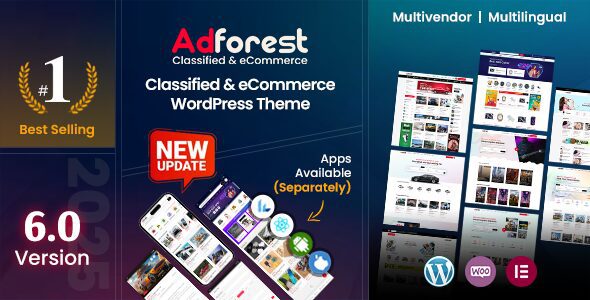
Business themes · Scriptsbundle
Launch a classified ads marketplace with paid packages, bidding, built-in messaging, WooCommerce payments and optional synchronized mobile apps.
File manifest
Downloads open on Loadpier in a new tab. Add only the files you need to your queue.
Package contents & compatibility
Release history & rollback
This is the current package in the catalog. Check the official product page for release details and compatibility notes.
Official product pageNo earlier package is currently available for this product.
Product overview
AdForest is a classic WordPress theme built for one job: running a classified ads site where registered users publish listings, visitors search and contact sellers, and the owner earns from placement fees rather than from shipping products. The package ships with multiple demos for general buy-and-sell boards, car dealers, real estate, pets and directory-style sites, plus a one-click demo importer. Since the 6.0 series the theme works with Elementor only — the vendor dropped WPBakery — so page building happens through Elementor widgets backed by a large Redux options panel.
If you need a general multipurpose theme instead of a classifieds engine, BeTheme or Essentials cover corporate sites, shops and blogs, but neither offers anything comparable for ad posting workflows.
The listing toolkit is the deep part. Search supports category, location, price, keyword and radius filters with ajax updates, and maps can run on Google Maps or the Leaflet/OpenStreetMap alternative. Category-based templates add custom fields per category, so a car listing can carry mileage fields while a pet listing carries breed fields. Ads support statuses such as featured, sold and expired, timed expiry, bump-up promotion, favorites and email alerts for saved searches.
On the user side there is a full front-end dashboard: people post and edit ads, manage packages, read internal messages and track profile views. Sellers get public profile pages with ratings and reviews, and a bidding module with countdown timers turns a listing into a mini auction. Moderation tooling includes a bad-word filter, manual or automatic ad approval, and phone verification through OTP providers.
Revenue runs through WooCommerce. The theme sells ad packages (bundles of listings with limits on featured ads, images or duration), pay-per-post submission, category-based pricing and paid bump-up or featuring upgrades, all checked out as WooCommerce products. That means gateways, taxes, coupons and refunds follow normal WooCommerce rules — and must be configured and exercised there, not assumed from the theme demo.
MultiVendorX integration extends the model toward a multi-vendor marketplace where sellers manage their own storefronts. If your real goal is a conventional product marketplace rather than paid listings, compare Dokan Pro, which approaches the same problem from the WooCommerce side.
The vendor sells native Android and iOS apps as separate products that synchronize ads, users and messaging with the WordPress site through an API. They are not inside this package. What the theme itself provides is a responsive front end, mobile search filters and two-column mobile grids, so the site works in mobile browsers without the apps. Budget for the apps separately if store presence matters, and expect extra setup work for publishing to Google Play and the App Store.
AdForest fits a new classifieds portal, a niche board for cars, property or pets, or a local directory that plans to charge for placement. It suits operators willing to run a moderately heavy stack: map API keys, OTP or social login providers, cron jobs for expiry and cleanup, email templates and WooCommerce configuration all need attention after launch.
It is a poor fit for a simple blog, a small business brochure site, or a store whose main business is shipping physical goods — the classifieds workflow dominates everything, and lighter themes would cost less effort to maintain.
The official documentation lists WordPress 6.0 or higher, PHP 8.0 or higher and MySQL 5.6 or higher, with at least 256 MB of WordPress memory and generous upload and execution limits for demo import. Every package passes ClamAV and heuristic checks before publication, and the file manifest lists the SHA-256 hash so you can verify the archive byte for byte.
One point deserves emphasis: a public security advisory (CVE-2026-1729) describes an authentication bypass affecting AdForest versions up to and including 6.0.12. Before deploying this exact version anywhere public, check whether this catalog carries a newer patched release and plan hardening accordingly. The package contains no license key, so vendor support and automatic updates are not available. The official changelog entry for exactly 6.0.12 could not be confirmed from vendor sources, so this card makes no claims about release-specific changes.
Back up the database and files, then extract the download locally without executing its code. On an isolated staging site, upload the theme ZIP through Appearance → Themes → Add New → Upload Theme, then add the required companion plugins the theme prompts for, including WooCommerce and Elementor. Import demo content only on staging, and remove sample ads, users and pages before launch.
Configure maps, OTP login, email templates, cron-driven expiry and payment gateways one at a time, then walk both journeys: a seller posting, paying and promoting an ad, and a buyer searching, bidding and messaging. Sites moving from AdForest 5.x must rebuild WPBakery layouts in Elementor first — the vendor’s own update notice warns about this. For rollback, restore the previous theme, plugins and database together; rolling back the theme alone can leave package and order data behind. Keep a full backup until both journeys pass on staging.
AdForest remains one of the most complete classified-ads themes on ThemeForest: ad posting, packages, messaging, bidding and WooCommerce payments arrive in one package, and the 6.0 line modernized the design around Elementor. The trade-off is maintenance weight — maps keys, OTP login, cron-driven ad expiry and payment gateways all need configuration and ongoing care. That complexity carries a security cost: a published critical advisory covers versions up to and including 6.0.12, so treat hardening and timely updates as mandatory, and check this catalog for a newer release.
Documentation review on November 15, 2026: official product information and marketplace listing were checked; no installation or runtime test was performed.
The package contains the complete premium version of the product — the same code the developer sells. A license key is not included, so automatic updates and vendor support tickets are not available; new versions appear in this catalog as they are released.
No. The vendor sells the native apps as separate products that synchronize with the site through an API. The theme itself provides a responsive front end for mobile browsers.
The 6.0 series works with Elementor only. WPBakery support was dropped at 6.0.0, so layouts from older 5.x sites must be rebuilt in Elementor before updating.
WooCommerce handles checkout for ad packages, pay-per-post submissions and featured or bump-up upgrades. Payment gateways, taxes and refunds are configured inside WooCommerce separately.
Every archive passes ClamAV and heuristic scans before it appears in the catalog, and the file manifest publishes the SHA-256 hash so you can verify the download byte for byte.
The official documentation calls for WordPress 6.0 or higher, PHP 8.0 or higher, MySQL 5.6 or higher and at least 256 MB of WordPress memory, plus generous upload and execution limits for demo import.