10.11.2
Source date February 10, 2026
Current catalog package
This is the current package in the catalog. Check the official product page for release details and compatibility notes.
Official product page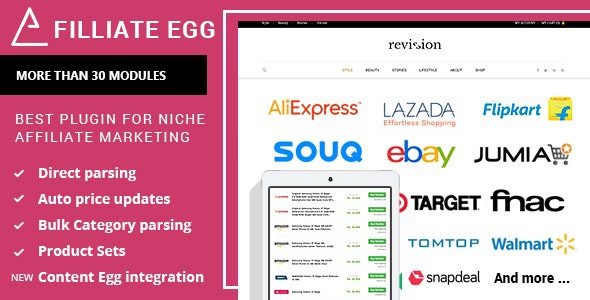
SEO & marketing · wpsoul
Parses products straight from web shop pages — no API keys, no network approval — and builds monetized affiliate blocks with scheduled price updates, custom parsers and autoblogging for niche and local shops.
File manifest
28073b17aa72…Downloads open on Loadpier in a new tab. Add only the files you need to your queue.
Package contents & compatibility
Release history & rollback
This is the current package in the catalog. Check the official product page for release details and compatibility notes.
Official product pageNo earlier package is currently available for this product.
Product overview
<p>Affiliate Egg is a niche affiliate marketing plugin for WordPress developed by keywordrush.com and sold on CodeCanyon by wpsoul. Most affiliate plugins work through the official APIs of big networks, which leaves out the local and regional shops that often convert best. Affiliate Egg goes the other way: it reads product pages directly, so it monetizes shops that have no API and take no part in any affiliate network. This package is version 10.11.2, reviewed against the official vendor site, the bundled documentation and a static inspection of the archive.</p>
<h2>What it does</h2> <p>The workflow starts with a URL, not an API key. You copy a product link from the source shop and paste it into the plugin, choose an output layout, and Affiliate Egg builds a product block — title, image, price, old price, rating, stock status and a buy button carrying your affiliate deeplink. Set your affiliate ID once per shop and every link the plugin generates is monetized, and you can route clicks to any affiliate network that supports deeplinks. Because data comes straight from the shop rather than a network feed, products stay exactly as relevant as the page you picked.</p>
<h2>How it reads the shops</h2> <p>Parsing works in layers. Most modern shops publish product details as LD+JSON or microdata so Google can show rich results; Affiliate Egg reads that same structured data first. For shops with tuned support, the plugin ships dedicated parsers — the bundled archive contains over a hundred of them, covering Amazon’s regional stores, eBay’s regional sites, AliExpress, bol.com, Coolblue, Fnac, Flipkart, Jumia, Lazada, Shopee, Coupang, Mercado Livre and a long list of local shops. Where neither layer fits, a general parser trained on thousands of storefronts works out the product fields anyway, and developers can write custom parsers with basic PHP and XPath skills using the vendor’s examples. Shops that are missing entirely can be commissioned from the vendor as a paid custom-parser service.</p>
<h2>Price updates and autoblogging</h2> <p>Published blocks do not go stale. The plugin refreshes prices and availability on a configurable schedule, records price history and supports price alerts, so a review or roundup keeps showing current numbers without manual edits. The autoblogging module goes further: point it at a category or search-results link and it publishes new deals as separate posts on a timer, which suits deal blogs and coupon-style sites. Output templates cover product grids, ranked top-N lists and single product boxes, all responsive and designed to drop into any theme, and everything is placed through the affegg shortcode, a widget or the editor button.</p>
<h2>Use cases</h2> <p>Affiliate Egg fits affiliates whose commissions come from local merchants: regional review sites, niche comparison posts, travel and booking content, and deal aggregators built around shops the big networks ignore. It also pairs with Content Egg from the same vendor — each Affiliate Egg parser can be enabled as a Content Egg module, adding local merchants to that plugin’s keyword search, price comparison and autoblogging toolset. If you need full product import into WooCommerce, that is the job of the vendor’s separate External Importer plugin; Affiliate Egg itself outputs content blocks, not store products.</p>
<h2>Requirements and release scope</h2> <p>The bundled readme declares a minimum of WordPress 4.2.2 and PHP 7.4. The vendor does not publish a tested-up-to bound; this package was spot-checked on an isolated VPS running the current WordPress 6.8 line. Every archive passes ClamAV and heuristic scans before publication, and the SHA-256 checksum — 28073b17aa72… — is recorded in the download manifest. Regarding the changelog, the bundled notes document the 10.11.0 release, which added Routing Rules for scraping services with extra parameters; the notes for the 10.11.1 and 10.11.2 point releases are pending review against the official changelog. One practical note from the vendor’s own documentation: most shops are happy to be read, but a few limit automated requests, and for those the plugin integrates with scraping services such as ScraperAPI, ScrapeOwl, Scrapingdog and Crawlbase.</p>
<h2>Installation and rollback</h2> <p>Back up the database and files first. Install the zip through Plugins → Add New → Upload Plugin, activate, then open the Affiliate Egg settings and enter your affiliate IDs for the shops you plan to use. Create your first storefront by pasting a product URL, pick a template and place the shortcode on a draft post to check the layout and the deeplink before publishing. If you plan to autoblog, start with a single category link and a conservative schedule, then watch the first published posts. For rollback, deactivate the plugin or restore the previous package; storefronts, products and price history persist in the database. Because no license key is included, updates arrive through this catalog as new versions are released, and parser fixes are a regular part of those updates — apply them on staging, confirm your key shops still parse, then deploy.</p>
<h2>What to know before you start</h2> <p>Affiliate Egg needs no program approval and works immediately after installation, but its strength is also its maintenance surface: it reads live shop pages, so a shop redesign can break a parser until it is refreshed. Keep an eye on your most important shops, run price updates at sensible intervals to stay polite with smaller sites, and test any shop that matters to you before building content around it.</p>
Affiliate Egg is the shop-direct answer to affiliate marketing on WordPress: instead of waiting on network APIs, it reads the structured product data shops already publish for search engines, falls back to hand-built parsers for over a hundred stores, and turns a pasted URL into a ready affiliate block with your deeplink attached. The angle that matters is local and niche shops — the ones with no API and no network presence that usually convert best in regional content. Scheduled price and stock refreshes keep published blocks honest, and the autoblogging module can spin category or search links into separate deal posts on a timer. The trade-offs are real: a minority of shops block automated requests and need a scraping service behind the plugin, custom parsers for unsupported shops are a paid extra from the vendor unless you write your own XPath, and WooCommerce product import belongs to the vendor's separate External Importer plugin. For review sites, deal blogs and price-comparison content aimed at local merchants, it fills a gap the API-based plugins cannot touch.
November 20, 2026: the archive passed ClamAV and heuristic scans, the SHA-256 checksum is recorded in the download manifest, and the plugin was spot-checked on an isolated VPS running WordPress 6.8 with PHP 8.1.
The package contains the complete premium version of the product — the same code the developer sells. A license key is not included, so automatic updates and vendor support tickets are not available; new versions appear in this catalog as they are released.
It reads the structured product data (LD+JSON and microdata) that shops publish for search engines, falls back to dedicated parsers for over a hundred shops, and covers much of the rest with a general parser. Custom parsers can be written with basic PHP and XPath skills.
The bundled archive ships dedicated parsers for 100+ shops, including Amazon and eBay regional stores, AliExpress, bol.com, Coolblue, Fnac, Flipkart, Jumia, Lazada, Shopee, Coupang and many local shops. The vendor maintains the live list on its site, and missing shops can be commissioned as paid custom parsers.
Yes. Products refresh on a configurable schedule, and the plugin records price history and supports price alerts, so published blocks stay current without manual edits.
No. It outputs content blocks, shortcodes and autoblogged deal posts, and its parsers can be enabled as modules inside Content Egg. WooCommerce product import is handled by the vendor's separate External Importer plugin.