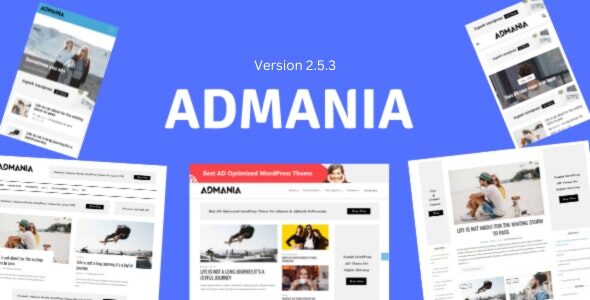
Admania is a classic blog and magazine WordPress theme built around one commercial goal: raising display-ad revenue. Version 2.5.3 comes from ThemeForest author userthemes01, and the design pairs a conventional editorial system with an unusually dense set of advertising slots. It targets AdSense publishers and affiliate marketers who prefer ad placement handled by the theme itself rather than by a separate ad-manager plugin.
For sites that need a broader newsroom feature set, compare Newspaper, JNews and Jannah. Those themes ship larger demo libraries and their own building stacks, while Admania stays narrower and lighter.
What the theme does
Admania turns a standard WordPress blog into an ad-monetized magazine. The official listing documents more than twenty homepage layouts, seven single-post layouts, a slider section, category and popular-post widgets, and three subscription box positions that connect to services such as Mailchimp and AWeber. The theme is marked Gutenberg-optimized, so articles are composed with native blocks instead of a proprietary builder, and an optional AMP layout targets fast mobile rendering. WooCommerce, Elementor, The Events Calendar, WPML and Contact Form 7 are named as compatible integrations, with translation readiness and RTL support for multilingual publishing.
Ad-placement system
The ad toolkit is the core selling point. The feature list describes more than twelve ad unit types, including header, sidebar, gallery, in-content, paragraph-level and post-bottom positions, plus sticky units for the header, footer and post sides, and a rotation unit for simple split testing. A front-end ad editor lets an administrator position units while viewing the page, ads accept HTML, image-link or AdSense code, and units can be disabled on selected pages. Shortcode support drops an ad option inside post content, and ad-blocker detection can nudge visitors who filter advertising.
Treat placement density as a dial, not a default. Sticky and interstitial-style units can lift click-through rate while also harming readability, layout stability and ad-network policy compliance, so configure conservatively and measure the result.
Editorial and magazine layouts
Homepage variants cover grid, list and slider-led arrangements, and a homepage widget builder assembles sections by dragging widgets into place rather than editing templates. Single posts offer seven layouts with related posts by category or tag, an author box, breadcrumbs and social sharing. Post formats cover video, audio, gallery and image content. The visual language is clean and conventional rather than distinctive; expect a competent magazine look that still needs custom colors, typography and imagery to avoid resembling other Admania sites.
Performance considerations
Ad revenue and speed pull in opposite directions, and the theme acknowledges that tension: the listing cites speed optimization work, schema integration and an AMP layout for mobile pages. Real-world performance depends on how many ad units, widgets and fonts a given configuration loads, since every extra slot means extra scripts and possible layout shifts. Measure the actual ad set on staging before launch, because no figure from a vendor demo predicts a production site carrying real ad tags.
Keep the subscription boxes, social widgets and slider disabled unless they earn their place. Each active module adds requests on every pageview, and an ad-heavy layout leaves little performance budget to spare.
Who it suits
Admania fits solo publishers and small teams running AdSense or affiliate content sites: niche blogs, list-style magazines and review sites where display income is the business model and placement control matters more than editorial tooling. It is a poor fit for brand-led publications, stores that lead with WooCommerce, or newsrooms that need editorial workflows, paywalls or a modern block-theme stack. Buyers who mainly want a distinctive design language should also look elsewhere, because the layouts prioritize ad visibility over visual identity.
Requirements and release scope
The marketplace attributes list WordPress 4.9.x through 6.3.x as the supported software range; exact minimum WordPress and PHP versions are not stated for this release and should not be assumed. Version 2.5.3 is dated November 29, 2023, so evaluate it against current WordPress and PHP on a staging copy before production use. Before publication the package goes through malware and heuristic scanning, and its SHA-256 hash is documented in the file manifest for verification. The package includes no license key, so automatic updates and vendor support are unavailable.
What changed in Admania 2.5.3
The official release log for November 29, 2023 lists eight fixes: compatibility with the then-current WordPress release restored, customizer fixes for mobile typography, a blocking-script issue fixed, incompatible theme options corrected, an error-log problem fixed, blank options in a few layouts repaired, custom-option importing aligned with current WordPress, and a duplicated list style in widgets solved.
Installation and rollback
Back up the database and uploads before touching a live site. Extract the download locally without executing its code, then on a staging site upload the theme ZIP through Appearance > Themes > Add New > Upload Theme. Configure ad units gradually, checking each position on desktop and mobile against the site’s ad-network policies. Import demo content only on staging and delete sample posts and pages before launch. For rollback, keep the previous theme folder and a complete database backup, and restore both together so ad settings are not orphaned. Verify the archive against the file manifest rather than trusting hashes quoted in prose.
Documentation review on November 15, 2026: official product information and marketplace listing were checked; no installation or runtime test was performed.